Industry
Solar Panel Pallet Shipping Cost: How to Calculate Delivered Cost
Learn how to calculate the true delivered cost of a solar panel pallet: module price per watt, freight, receiving location, pickup trade-offs, damage procedures and quote comparison.

Price per watt is often the first number buyers compare when purchasing a pallet of solar panels. For a local dealer, installer, or system provider, however, it tells only part of the story. It shows the cost of the modules, but not necessarily the cost of getting them to a warehouse or jobsite.
A warehouse-pickup quote, a freight-included quote, and a jobsite-delivery quote may cover different services. Without matching the quantity, destination, and delivery conditions, a lower module price can appear more competitive simply because some costs have been left out.
A useful comparison starts with a practical question: what does each quote include, and what will the buyer still need to arrange and pay for?
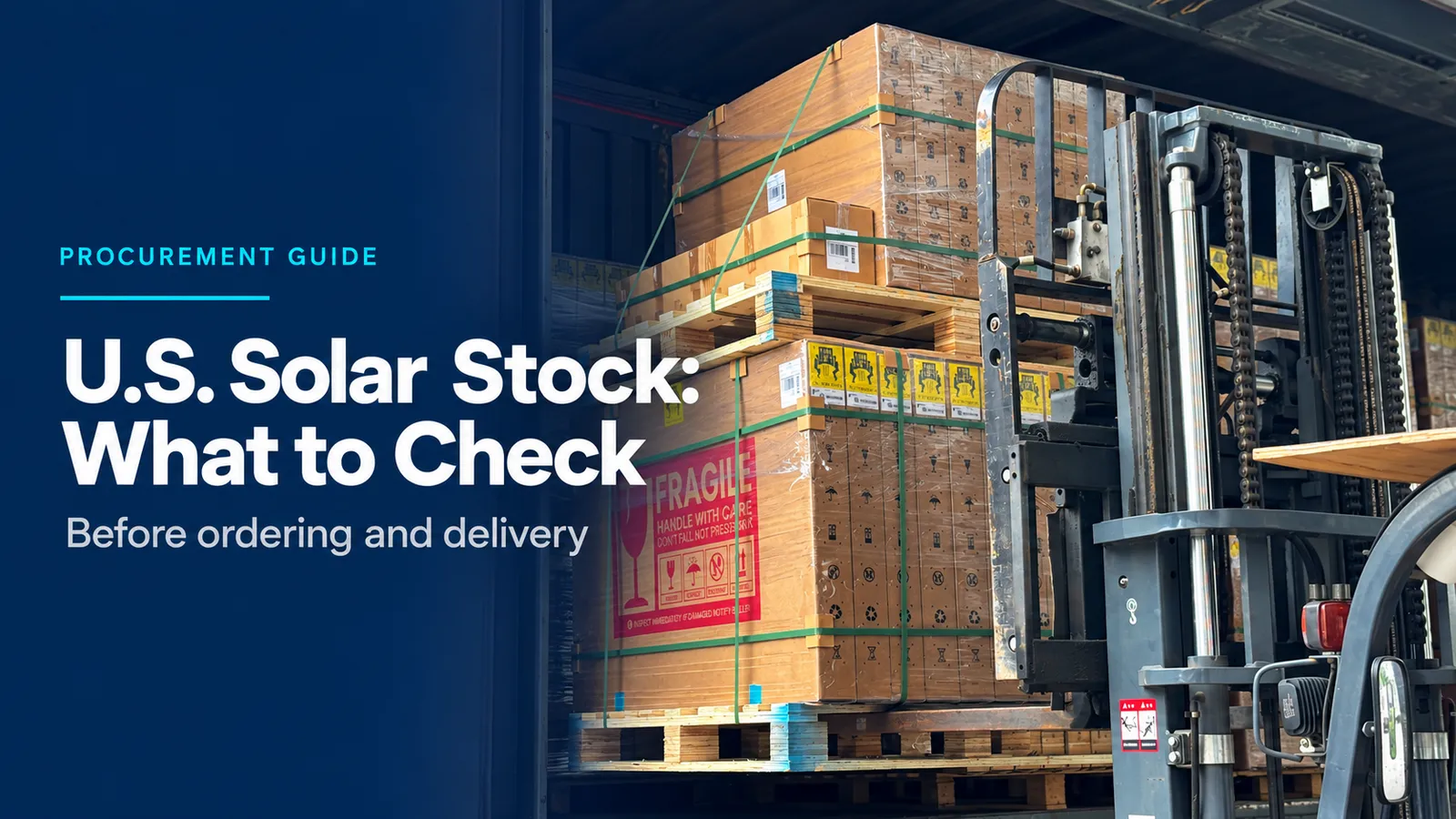
A pallet is a shipping unit, not a fixed quantity of solar panels. Module dimensions, weight, and packaging configuration affect how many panels are included. Comparing two pallet prices therefore requires checking the exact model, rated wattage, and panel count first.
For example, the Callsun CS450W datasheet specifies 36 modules per pallet. At 450W per module, the pallet contains 16,200W, or 16.2kW, of rated module capacity. This is the sum of the modules’ nameplate ratings—not daily energy production or a promise of continuous output under field conditions.
Dividing the module subtotal by the pallet’s total rated watts gives the module price per watt. To compare delivered cost, the calculation must also include freight and applicable delivery charges.
Price comparisons are meaningful only after the products meet the buyer’s requirements. Two 450W modules may have different dimensions, electrical characteristics, documentation, product conditions, and warranty terms. Matching wattage alone does not make them interchangeable.
Consider the following hypothetical example. These figures illustrate the calculation and are not actual Callsun or supplier quotations.
Both suppliers offer 36 modules rated at 450W each. Supplier A quotes $0.30/W, giving a module subtotal of $4,860. Freight and delivery services to the specified address add $600.
Supplier B quotes $0.32/W, giving a module subtotal of $5,184. Freight and equivalent delivery services add $250.
Supplier A’s total is $5,460, or approximately $0.337/W. Supplier B’s total is $5,434, or approximately $0.335/W. Although Supplier A’s module price is two cents per watt lower, Supplier B’s delivered total is slightly lower. Taxes are excluded from this example; applicable taxes should be addressed consistently in an actual comparison.
The calculation is straightforward:
Delivered cost per watt = (module subtotal + freight + applicable delivery charges) ÷ total rated module watts
If taxes or other transaction costs are included, identify them explicitly and apply the same comparison basis to each quotation.
For a 16.2kW pallet, every additional $100 adds approximately $0.0062/W. The same freight charge has a larger effect when spread across fewer panels. This is why a competitive module price can become an expensive small-quantity purchase once delivery is added.
A city name alone is usually insufficient for a usable freight quotation. The destination ZIP code, address type, vehicle access, unloading equipment, and appointment requirements can affect both the service and its cost.
For 450W solar panels by the pallet from U.S. stock, check Callsun’s current warehouse availability in California, Texas and New Jersey. Each pallet contains 36 panels with a combined rated power of 16.2 kW. Request a delivery quote for your destination ZIP code or ask about warehouse pickup.
A commercial warehouse with a loading dock or forklift has different receiving conditions from a residential property or remote site without unloading equipment. Buyers should confirm whether the quote includes a liftgate, delivery appointment, limited-access service, or other required services.
The delivery point also matters. Delivery to an address does not necessarily include moving the panels inside a building or carrying them to the installation area. Those responsibilities should be confirmed before dispatch.
Freight dimensions and weight must come from the actual packaging information. The Callsun CS450W datasheet lists a module weight of 23.97kg. Thirty-six modules therefore weigh approximately 862.92kg before the pallet and packaging are added. That figure is not the shipment’s gross weight. Likewise, individual module dimensions do not establish the dimensions of the packed pallet.
A practical freight quote should identify the shipment quantity, origin, destination, included services, and validity period. Changes to the order or receiving conditions may require a revised quote.
Local pickup can reduce delivery charges, but the buyer still needs a suitable vehicle, people, time, and handling arrangements.
For a nearby dealer with appropriate transport already available, pickup may be economical. For a buyer who must rent a vehicle, arrange additional help, and make a long round trip, freight delivery may be the better option.
Compare the alternatives on the same basis. Vehicle rental, fuel, staff time, and necessary equipment are part of the pickup cost. Confirm the warehouse’s appointment requirements, loading assistance, and actual packaging dimensions before choosing a vehicle.
Pickup may also allow the buyer to check the model, quantity, and visible condition before leaving. That inspection is useful, but it does not replace product documentation or internal quality testing. The decision should account for both transport cost and the buyer’s ability to handle and inspect the shipment.
An installer can use delivered cost in a project’s material budget. A dealer buying for resale must also consider how the pallet will turn into sales.
Suppose a project needs 30 modules and the purchase unit contains 36. The remaining six may be useful for confirmed future work or existing customer demand. If their only destination is “we will probably sell them later,” the purchase also creates storage, handling, selling, and cash commitments.
Unused modules should not automatically be treated as consumed by the current project, nor should their expected resale value be counted as realized revenue. Assess the current requirement and the remaining inventory separately.
For a dealer, the difference between purchase price and retail price is not net profit. Breaking down a pallet creates work: moving panels, storing loose stock, answering questions, fulfilling small orders, and handling after-sales issues.
Buying a pallet to replenish an established sales channel is a different decision from buying one because the unit price looks attractive. The discount is only useful if the inventory fits the business.
Transport damage cannot always be assigned a reliable dollar value before ordering. The response procedure, however, can be clarified.
Buyers should understand the packaging and freight arrangements, receiving-inspection requirements, documentation needed for a claim, and the party responsible for handling the issue.
For a project designed around a specific panel count, one damaged module may create replacement freight costs and a scheduling delay. Refunding the module’s purchase price may not be enough to keep the installation moving. Confirm whether a matching replacement can be supplied, how long it may take, and who pays the associated costs.
Factory testing and receiving inspection serve different purposes. Factory testing checks the module before release; receiving inspection checks the shipment after transport. Clear procedures at both stages make discrepancies easier to identify and resolve.
A useful quotation request includes the required model, panel or pallet quantity, destination ZIP code, address type, unloading conditions, and required pickup or delivery date.
The supplier’s response should state the module subtotal, freight and delivery charges, treatment of applicable taxes, delivery method, and quotation validity.
The purchasing decision is whether the required modules can be obtained at an acceptable total cost under workable delivery conditions. Price per watt helps narrow the options. Freight, receiving arrangements, and inventory use determine whether the order makes sense.
Callsun supports module selection and specification review based on the intended application. Providing the required quantity, destination, and receiving conditions helps establish a clearer supply and delivery assessment. Inventory, pricing, and transport arrangements remain subject to order confirmation.
Tagged
Next step
Need a delivered-cost quotation for a pallet order?
Share the target model, quantity, destination ZIP code and receiving conditions - Callsun will support module selection, freight arrangement and documentation for a comparable quotation.
Contact Callsun