
Industry
Solar Panels in Stock in the USA: What to Check Before Ordering and Delivery
What to confirm before ordering US-stock solar panels: allocation status, exact model, release and arrival dates, pickup or delivery fit, receiving inspection and problem resolution.
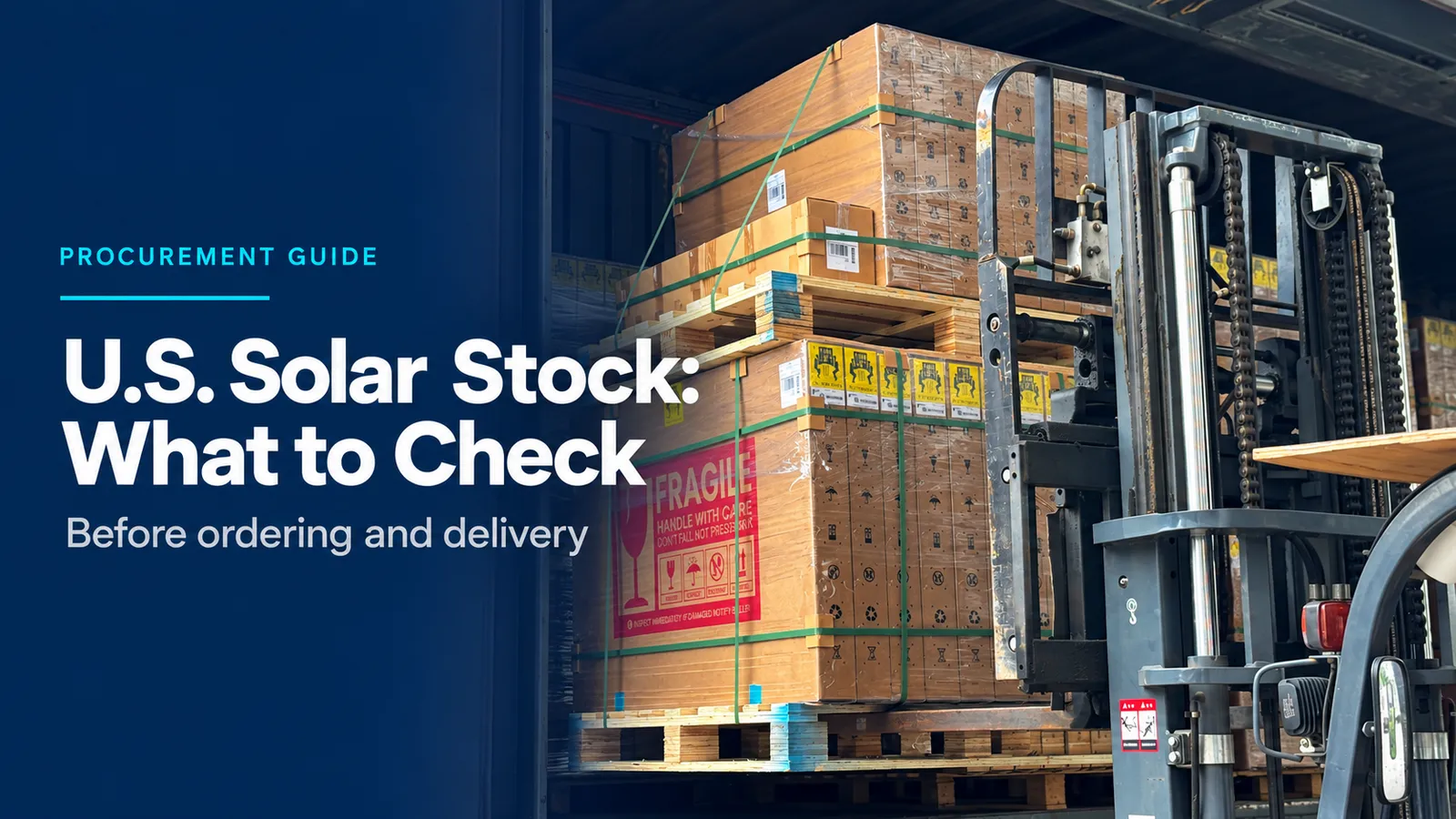
U.S. stock can shorten the distance between a purchase decision and an installation. For a local dealer or small installer, that can mean fewer arrangements to manage and less time waiting for equipment.
But “in stock” does not answer every question needed to place an order. The modules may be at a warehouse awaiting release, available through another supplier, or part of an incoming shipment. Even when the panels are physically present, the required quantity, pickup arrangements, and delivery schedule still need confirmation.
The useful question is whether the specific modules can be allocated, released, and delivered under conditions that work for the buyer.
A stock listing should lead to a clear explanation of the product’s location and availability.
Modules already received and available for release are different from modules awaiting inspection or an inbound shipment with an estimated arrival date. Stock held at a third-party warehouse can be a workable supply arrangement, provided the seller can verify the quantity and coordinate its release.
Ask whether the listed stock is available to purchase now, whether it has already been allocated to another order, and what must happen before collection or dispatch. A website quantity can be useful, but it should not replace confirmation for the order.
This matters when a crew, vehicle, or project schedule depends on the equipment. An expected arrival date and a confirmed release date represent different levels of certainty.
A wattage category is not a complete product specification. Two 450W modules may differ in dimensions, voltage, current, structure, mounting requirements, and applicable documentation.
The quotation and order confirmation should identify the exact model and quantity. They should also state whether the modules are new, used, surplus, or another defined condition. If photographs, labels, and technical documents refer to different products, resolve the discrepancy before payment.
For example, the Callsun CS450W datasheet specifies 36 modules per pallet, representing 16.2kW of rated capacity. It lists module dimensions of 1762 × 1134 × 30mm, an operating voltage of 29.73V, and an operating current of 15.14A under standard test conditions. These details help identify and assess the product; they do not establish compatibility with every inverter, controller, or mounting system.
For project orders, check that the supplied model matches the design requirements and that the necessary documents apply to that model. Agree how substitutions will be handled. A higher-wattage replacement may still require technical review.
A supplier may have stock without being able to release it immediately. Payment clearance, warehouse appointments, order preparation, and carrier collection can affect dispatch.
Ask when the stock can be reserved, how long the reservation lasts, and what is required to release it. For pickup, obtain the location, appointment process, collection reference, and loading arrangements. For delivery, distinguish the expected dispatch date from the expected arrival date.
An estimated freight transit time should not be treated as a guaranteed project schedule. Where timing is critical, clarify which commitments the supplier and carrier are making and what happens if the schedule changes.
Accurate dates help buyers plan. A clear explanation of the remaining steps is more useful than an unsupported promise of fast delivery.
Local pickup may suit buyers with appropriate transport and handling capacity. Freight delivery may be more practical for buyers farther away or for sites where arranging collection would consume significant time.
Either option requires the actual packed dimensions and gross weight. Individual module specifications cannot substitute for shipment data.
The Callsun CS450W datasheet lists a weight of 23.97kg per module. Thirty-six modules therefore weigh approximately 862.92kg before the pallet and packaging are included. The complete shipment will be heavier, and its packed dimensions must be obtained separately.
For pickup, confirm that the vehicle can accommodate the load and that the warehouse can load it as arranged. Agree who is responsible for securing the shipment and follow the applicable handling instructions.
For delivery, confirm vehicle access, unloading equipment, and the agreed delivery point. A site without a loading dock or forklift may need a liftgate or another unloading arrangement. Delivery to the address does not necessarily include moving panels into storage or carrying them to the installation area.
These details should be resolved before the shipment is booked.
Receiving is easier when the person accepting the shipment knows what should arrive and what to check.
Keep the order confirmation, model details, expected quantity, and contact information available. Allow sufficient space and time for the inspection permitted by the delivery arrangements.
Start with the pallet and external packaging. Look for visible signs of impact, instability, torn protection, or other abnormalities. Check product identification and quantity where accessible. Photograph the shipment and any visible damage before moving or unpacking it.
Follow the agreed receiving and carrier procedures when recording discrepancies. Requirements for delivery receipts, refusal, concealed damage, and claim deadlines can vary. Obtain those instructions before delivery rather than assuming one procedure applies to every shipment.
A visual check has limits. It can identify visible damage and discrepancies, but it cannot establish the condition of every cell or internal connection. Factory EL and I-V testing serve a different purpose from receiving inspection, and transport can introduce damage after factory release.
Before ordering, identify who handles shortages, damage, and product discrepancies. The seller, warehouse, carrier, and manufacturer may have different responsibilities.
Clarify what evidence is required, whom to contact, and whether the proposed remedy is a refund, replacement, or another agreed solution. For an installer, a refund may leave the project short of a module. Ask whether the same model can be supplied individually, how long replacement may take, and who pays the freight.
Keep immediate delivery issues separate from longer-term warranty claims. A missing panel, visible freight damage, and a suspected product defect may follow different procedures. The buyer should not have to discover those distinctions while a crew is waiting.
A workable response process does not mean every problem can be resolved instantly. It means the parties know who will act and what information is needed.
A pallet may meet today’s requirement without providing a repeat supply option. That can be acceptable for a one-time project, but it has different implications for a dealer building a product range or an installer standardizing equipment.
Ask whether the model is part of ongoing supply or a finite clearance lot. Confirm whether future availability is established, expected, or unknown.
For a reseller, this affects repeat customer orders and the usefulness of product materials. For an installer, it affects future designs and replacement planning. Neither buyer should assume that current stock guarantees long-term availability.
The right purchase depends on the intended use. A finite lot can be suitable when its quantity and specifications match a defined need. Repeat procurement requires a separate supply discussion.
Before committing, the buyer should be able to identify the exact model, available quantity, stock location, release conditions, delivery arrangements, receiving requirements, and contact for discrepancies.
These confirmations give practical meaning to “in stock in the USA.” They connect the inventory claim to the work the buyer needs to complete.
Callsun supports module specification and application review. Buyers can provide the required quantity, destination, receiving conditions, and project schedule so that supply and delivery requirements can be assessed together. Specific inventory, release dates, transport services, and after-sales arrangements should be confirmed in the order documentation.
Tagged
Next step
Checking US stock availability for your project?
Share the required model, quantity, destination and schedule - Callsun will confirm availability, release timing, transport options and receiving support for a plannable order.
Contact Callsun