Industry
Buying Solar Panels by the Pallet for Resale: A Dealer's Guide
Planning to resell solar panels? Evaluate local demand, landed cost, selling margin, storage, documentation and replenishment before buying a pallet.

Buying a pallet of solar panels and selling smaller quantities can serve a practical local need. Customers may require only a few modules, prefer nearby collection or want to inspect a product before purchasing.
For a reseller, the opportunity depends on more than securing a low purchase price. The modules must fit local demand, the selling price must cover the work involved, and stock must move quickly enough to justify the cash committed.
Before placing a pallet order, evaluate the specific model, the customers likely to buy it and the conditions under which you can supply them.
Start with Customers You Can Actually Reach
A discounted pallet is not evidence of demand.
Start with inquiries, previous sales or existing customer relationships. Identify which power ratings, dimensions and product characteristics buyers request—and how many modules they normally purchase.
A local installer buying for several confirmed jobs has different requirements from a homeowner seeking two matching replacement panels. An off-grid equipment customer may need electrical compatibility with an existing charge controller. A small retailer may prioritize a format that customers can transport and collect easily.
Before ordering, establish:
If your plan relies on local listings or a new sales channel, test buyer interest before committing to stock. Competing asking prices can help frame the market, but they do not prove that products sell at those prices.
Choose a Module That Fits Your Sales Channel
Rated wattage is only one part of product selection.
Check dimensions, weight, electrical characteristics, construction and connectors against the applications your customers have in mind. A higher-wattage module may offer attractive cost per watt while being less convenient for transport, handling or certain installations.
Documentation also affects saleability. Confirm which datasheet, labels, certification documents and warranty terms apply to the batch offered. Do not assume that every buyer can use a module simply because its rated power is suitable.
For a model-specific reference, review the CALLSUN CS450W specifications. Confirm the specifications and documentation of the batch being quoted before placing an order.
Calculate Your Landed Cost Before Setting a Selling Price
The supplier’s module price is not your complete inventory cost.
Build the calculation around the actual quotation. Include the module subtotal, freight or collection costs, applicable non-recoverable taxes and other charges required to bring the stock to your selling location.
Divide that total by the number of saleable modules to establish a starting cost per panel.
Then account for the work of selling smaller quantities: payment fees, handling, storage, advertising, local delivery and customer support. Some costs belong to individual sales; others apply to the business over a period. Keep them separate so the calculation remains understandable.
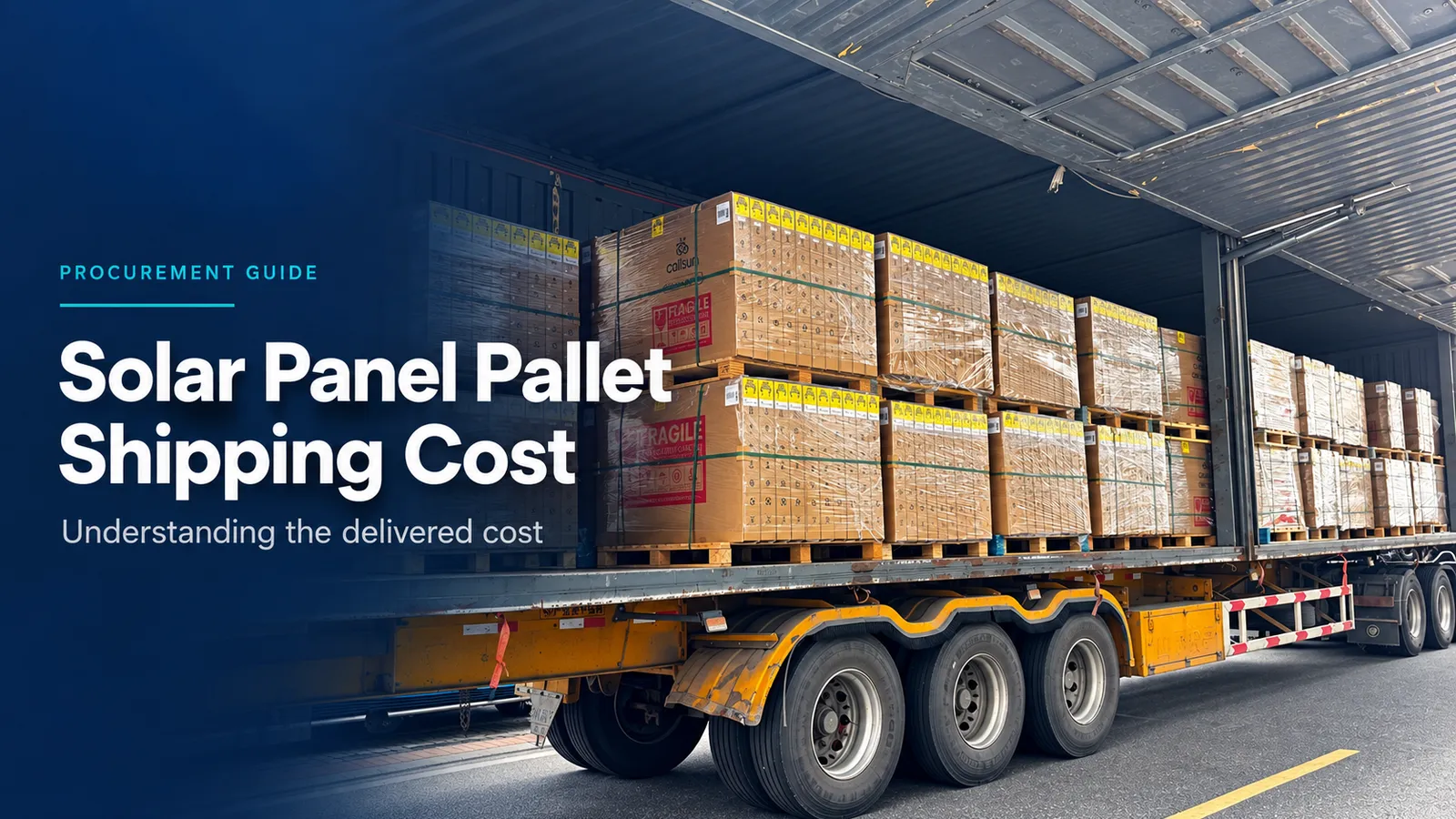
For a more detailed freight comparison, see Solar Panel Pallet Shipping Cost: How to Calculate Delivered Cost.
Separate Markup from Margin
Consider this hypothetical example. These figures illustrate the calculation and are not a CALLSUN quotation or an expected resale price.
The $30 difference represents a markup of approximately 22.2% on the $135 landed cost. As a share of the $165 selling price, it is approximately 18.2%.
That difference still needs to cover selling and operating expenses. If payment fees, handling and other variable selling costs total $10 per module, the contribution falls to $20 per module before fixed overhead, taxes and any additional losses.
If all 36 modules sell under those assumptions, total revenue is $5,940. After the $4,860 inventory cost and $360 in variable selling expenses, $720 remains before the other costs mentioned above.
The calculation only works if the assumed selling price and sales volume are achievable. A lower selling price, unsold stock or replacement expense changes the result.
Plan How the Pallet Will Become Smaller Orders
Breaking down a pallet creates a different fulfillment process from receiving one.
Confirm the packed dimensions, gross weight and unloading requirements before dispatch. Then plan how individual modules will be stored, identified, inspected and handed over to customers.
Useful operational questions include:
Follow the applicable handling and storage instructions. If you offer delivery, calculate its cost separately rather than assuming the panel margin will absorb it.
A local collection model and a nationwide single-panel delivery model have very different cost structures.
Decide How Much Cash You Can Leave in Stock
An attractive margin does not guarantee a quick return of cash.
Using the example above, the reseller commits $4,860 before sales begin. Selling part of the pallet brings cash back into the business, but the remaining modules still require storage and a route to customers.
Build your purchasing plan around realistic sales timing. Consider what happens if demand is slower than expected, a customer cancels or competitors reduce their prices.
Set a review point for unsold stock. Decide in advance when to reassess pricing, promotion or purchasing volume. Avoid placing a second order solely because the first pallet had a good unit price.
For a first purchase, the smallest workable order can provide useful evidence about demand and fulfillment before a larger commitment.
Clarify Your Responsibilities to the Next Buyer
Customers buying from you need a clear account of what they are receiving and who supports the product.
Confirm what product information and warranty terms you can pass on. Ask the supplier whether coverage transfers on resale and what records are needed for a claim. Establish how transport damage, product concerns and matching replacement requests will be handled between your business and the supplier.
Keep your own sales descriptions consistent with the supplied documents. Distinguish manufacturer-backed terms from services your business provides.
If customers need installation or system design advice beyond your service scope, make that boundary clear before the sale.
Check Replenishment Before Promising Ongoing Supply
A successful first pallet may lead to requests for more of the same module.
Ask whether the model is part of an ongoing supply program or a limited batch. Confirm how later availability, order quantities and lead times are assessed.
Do not promise that a future batch will have identical specifications, appearance or documentation without confirmation. An alternative module may require another compatibility review, especially when a customer is expanding an existing installation.
For a regional dealer, reliable communication about replenishment can be as useful as the initial quotation.
Make the Purchase Decision Around Your Business
A pallet order is more attractive when you have identifiable customers, workable receiving arrangements and a selling price that covers the full cost of serving them.
Before committing, you should be able to explain who will buy the model, how orders will be fulfilled, what support you will provide and how much cash you can reasonably hold in inventory.
If those answers remain uncertain, gather more customer and supplier information before increasing the order.
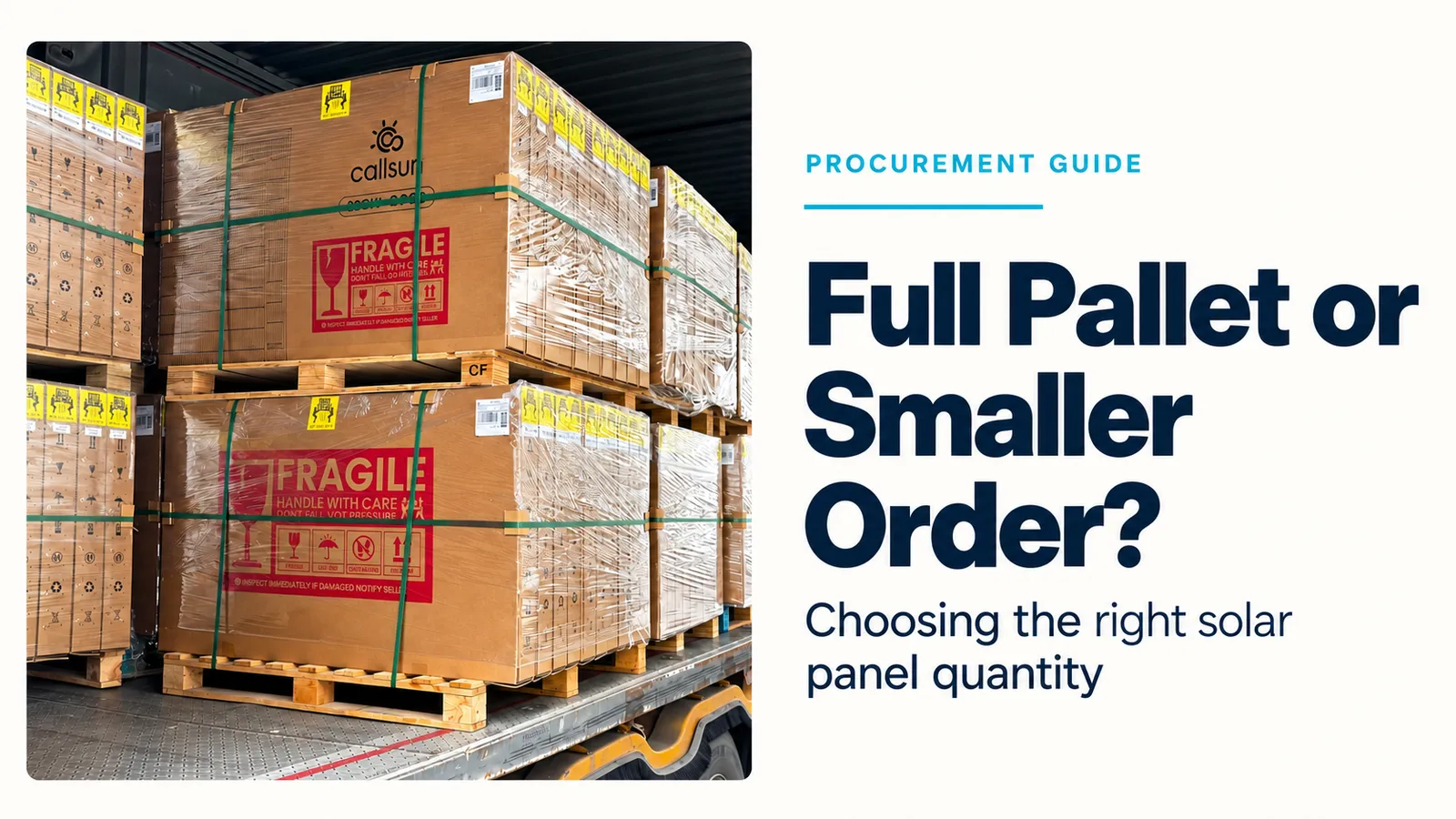
For a broader quantity decision, read Buying Solar Panels by the Pallet vs. Smaller Quantities.
Tagged
Next step
Exploring 450W Modules for Local Resale?
Review CALLSUN’s 450W U.S. stock and pallet purchasing options. Share your preferred module finish, pallet quantity, destination ZIP code and intended resale application. Ask the team to confirm the available batch, product documents and pickup or delivery quotation for your business.
View 450W U.S. Pallet Stock