Technical
Solar Panel Quality Control: What EL and I-V Testing Tell Buyers
Learn what EL inspection and I-V testing reveal about solar panel quality, where they belong in module production, and what B2B buyers should verify.
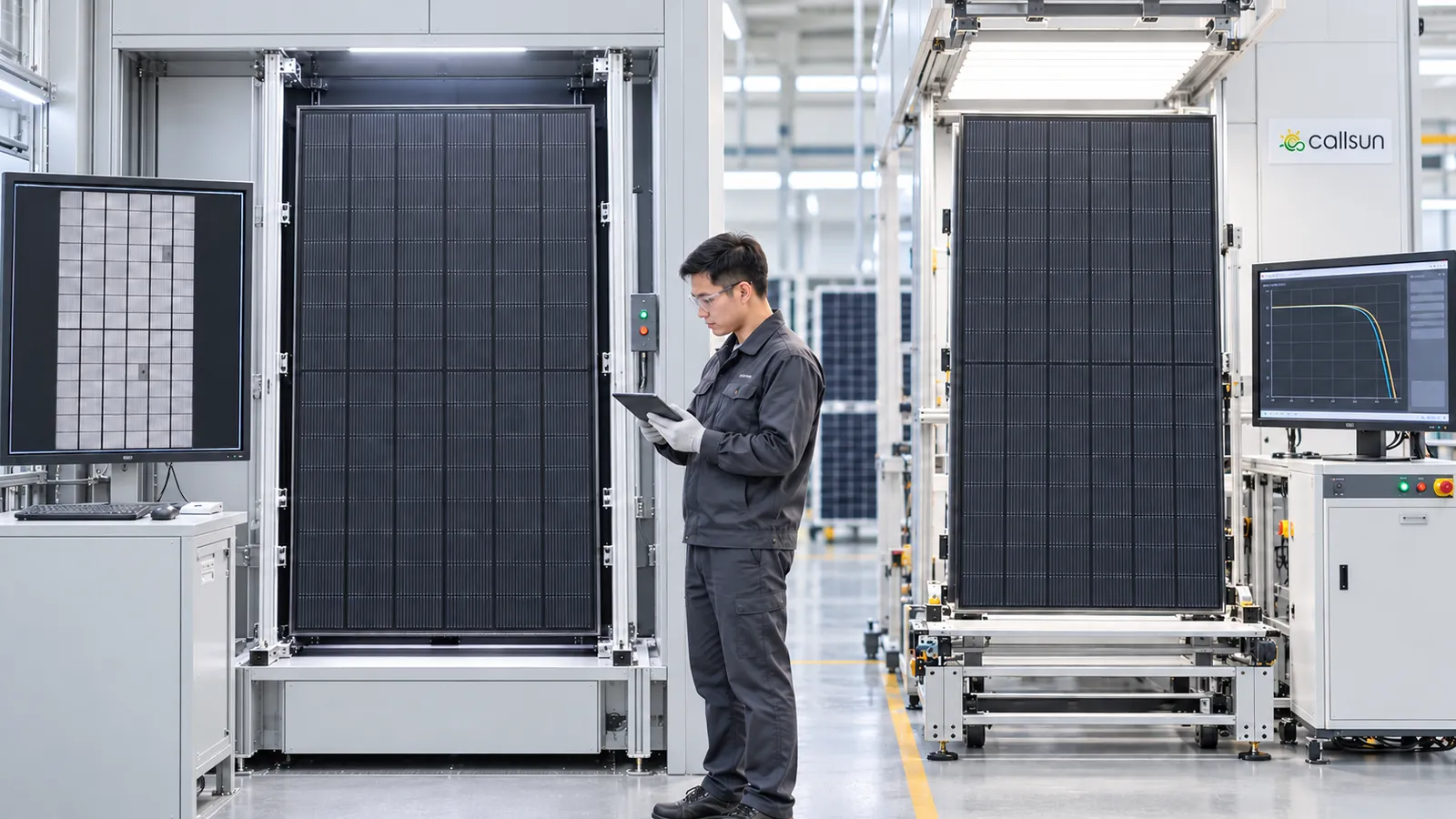
Solar panel quality control cannot be reduced to a final visual inspection or a single electrical measurement before shipment. A module may look normal from the outside while still containing cell cracks, soldering abnormalities, inactive areas, or internal connection issues. It may also appear structurally sound but fail to deliver the expected electrical output under controlled test conditions.
This is why electroluminescence inspection and I-V testing are commonly used at different stages of PV module manufacturing. They examine different aspects of the product: EL inspection helps reveal the internal condition of cells and interconnections, while I-V testing measures the module’s electrical performance.
For B2B buyers, however, confirming that a manufacturer owns this equipment is not enough. The more useful questions are where these tests occur in the production process, what they are intended to identify, how the results are evaluated, and whether the testing applies to the exact product being purchased.
Solar Panel Quality Control Is a Process, Not a Final Check
Module quality is shaped throughout production.
Cell cutting, string welding, layup, lamination, framing, junction-box installation, cable assembly, and handling can all affect the finished product. Some abnormalities can be seen during an external inspection, but others remain inside the laminate or electrical circuit.
A meaningful solar panel quality control process therefore covers raw materials, semi-finished products, critical manufacturing steps, finished-module testing, and final release. Inspection results should be used to identify problems while corrective action is still possible, rather than being treated only as documentation produced at the end of the line.
EL inspection and I-V testing are important within this process, but they do not serve the same purpose and should not be treated as interchangeable.
What Is EL Testing for Solar Panels?
Electroluminescence testing applies an electrical current to a solar cell or module and captures the resulting near-infrared emission with a specialized camera. The resulting EL image shows differences in the electrical activity of the cells and internal conductive paths.
In practical terms, EL inspection allows manufacturers to examine conditions that are difficult or impossible to confirm through an ordinary visual inspection. Depending on the type and severity of the abnormality, the image may indicate cell cracks, broken conductive areas, soldering problems, interrupted interconnections, or electrically inactive regions.
EL images are not simply photographs of the module interior. They require interpretation. Differences in brightness, shape, location, and continuity may represent different conditions, and not every visible line has the same effect on output or long-term reliability.
For this reason, an EL result should be reviewed against defined inspection criteria by personnel who understand both the manufacturing process and the product structure. The test is most useful when it is connected to a clear decision: whether the product can proceed to the next production stage, requires further examination, or should be removed from the process.
Why the Timing of EL Inspection Matters
EL inspection can be performed more than once during module manufacturing. Testing at different stages serves different quality-control purposes.
For standard modules, Callsun conducts in-process EL inspection after string welding. At this point, the manufacturer can examine the condition of the cells and welded strings before subsequent assembly steps make rework more difficult.
For custom glass modules, where product dimensions and internal layouts may vary, EL inspection is performed before lamination. This helps check the cell arrangement and internal connection condition before the structure is permanently laminated.
A final EL inspection is conducted after lamination and framing. This stage rechecks the cells and internal connections after the module has passed through major manufacturing processes involving heat, pressure, handling, and structural assembly.
The value of using both in-process and final EL inspection lies in their different positions in the manufacturing sequence. An in-process inspection can help identify an abnormality close to the stage where it occurred. A final inspection checks the module after the main assembly work has been completed.
Final EL inspection should not be viewed as a substitute for process control. If testing occurs only after the module is finished, it may confirm that a problem exists without providing the same opportunity to identify and address it earlier in production.
What EL Testing Can and Cannot Confirm
EL testing is particularly useful for examining the internal electrical activity of the cells and interconnections. It can provide evidence of conditions that are not visible from the surface and can support investigation when an abnormality is found.
It does not, however, provide a complete judgment on every aspect of module quality.
An EL image does not directly confirm the module’s rated power, voltage, or current. It does not replace visual inspection, electrical safety testing, material control, mechanical examination, or reliability testing. It also does not by itself predict exactly how every visible cell condition will affect long-term field performance.
The influence of a cell crack, for example, depends on its position, orientation, electrical isolation, development over time, and the operating conditions of the module. EL inspection provides important evidence, but the result must be evaluated in context rather than converted into an unsupported lifetime-performance claim.
B2B buyers should therefore be cautious when an EL image is presented as complete proof of product quality. It is one part of a broader inspection and release process.
What Is I-V Testing for Solar Panels?
I-V testing measures the relationship between the current and voltage produced by a PV module under controlled illumination. The test generates an I-V curve and records key electrical values used to assess module performance.
Depending on the equipment and reporting format, the test may record output power, open-circuit voltage, short-circuit current, operating voltage, operating current, and other characteristics derived from the I-V curve.
For factory release, the main purpose is to verify whether the finished module meets the electrical requirements of its designated power class and product specification.
This is different from EL inspection. EL testing produces an image of electrical activity across the cells and internal connections. I-V testing evaluates the electrical output of the module as a complete device.
A module can therefore require both. An I-V result may show that total output is outside the expected range but may not clearly identify the physical location or cause of the problem. An EL image may reveal an abnormal area but does not independently quantify the module’s rated electrical output.
Why Test Conditions and Equipment Control Matter
An I-V result is meaningful only when the test conditions and equipment are properly controlled.
PV module output changes with irradiance, cell temperature, spectrum, measurement timing, and equipment accuracy. Solar simulators and measurement systems must therefore be maintained and calibrated according to the manufacturer’s quality procedures and the applicable testing requirements.
Buyers should not compare two I-V reports purely by looking at the reported peak wattage if the measurement conditions, equipment class, correction method, or product configuration are different.
The identification of the tested product also matters. The module model, rated power class, and relevant electrical data should correspond with the product being supplied. When several product variants share a similar external appearance, incomplete product identification can create confusion about which result applies to which module.
For wholesale and project orders, buyers should clarify how electrical test results are recorded, associated with production batches or products, and used in the final release process. The level and format of data available to the buyer should be confirmed as part of the order requirements rather than assumed.
EL and I-V Testing Work Better Together
EL inspection and I-V testing answer different questions.
EL inspection asks whether the cells and internal conductive paths show visible electrical abnormalities. I-V testing asks whether the completed module delivers the expected electrical characteristics under controlled illumination.
When used together, they provide a more complete view than either test can provide alone. A manufacturer can examine both internal cell and interconnection conditions and finished-module electrical output before release.
The relationship between the two tests can also support problem investigation. If an I-V result falls outside the expected range, EL inspection may help locate an inactive or abnormal area. If an EL image shows a possible internal issue, the electrical data can help determine whether the module’s overall output has also been affected.
Even together, however, EL and I-V testing do not cover every form of quality and reliability evaluation. They must remain part of a wider system that includes material checks, process inspections, visual examination, electrical safety testing, and appropriate reliability validation.
Routine Production Testing Is Not the Same as Reliability Testing
This distinction is important for B2B buyers.
EL and I-V tests used during production help evaluate the condition and electrical performance of cells, semi-finished products, or completed modules at defined manufacturing stages. Reliability testing examines how materials, structures, or module designs respond to environmental and mechanical stresses under specified test conditions.
Examples may include damp-heat exposure, thermal cycling, ultraviolet aging, static mechanical load testing, and withstand-voltage or insulation testing. These tests support material evaluation, sample development, process validation, and production improvement.
They should not automatically be understood as identical, full-duration tests performed on every module leaving the production line. The test scope, sampling method, applicable model, acceptance criteria, and purpose should be clarified.
Similarly, passing a laboratory reliability test does not remove the need for correct system design, transportation, handling, installation, and field maintenance. Module performance in service depends on both the product and the conditions under which it is transported, installed, and operated.
What Should B2B Buyers Verify?
When evaluating a PV module manufacturer, buyers should move beyond the question, “Do you conduct EL and I-V testing?”
They should understand which production stages include EL inspection, whether final modules receive EL and I-V checks, and how results are evaluated before release. They should also confirm that the testing process applies to the specific product type and production line involved in the order.
The following points deserve particular attention:
- Is EL inspection performed during production, after final assembly, or at both stages?
- At what stage is in-process EL conducted for the relevant module type?
- What types of abnormalities are included in the inspection criteria?
- Is final I-V testing performed under controlled conditions?
- How are the module model and power class identified in the test data?
- What happens when an EL image or I-V result falls outside the acceptance criteria?
- Which reliability tests support the product design or production process?
- Can the required inspection records or reports be provided in the agreed format?
- Do the reports and technical documents correspond to the exact model being purchased?
These questions help buyers determine whether testing is genuinely integrated into production or used only as a general sales statement.
How Callsun Integrates EL and I-V Testing into Production
Callsun’s quality control covers raw materials, semi-finished products, critical process steps, and final product release.
For standard modules, the fully automated production process includes non-destructive cell cutting, multi-busbar string welding, post-welding in-process EL inspection, vision-guided layup, controlled high-temperature vacuum lamination, automated framing, and final EL and I-V testing.
For custom glass modules, the production process combines semi-automated manufacturing with manual operations according to the product’s dimensions and structural requirements. It includes cell cutting, string welding, layup, pre-lamination EL inspection, lamination, edge trimming, framing, and final EL and I-V testing.
Simulated-sunlight I-V testing records power, voltage, current, and the I-V curve to verify the module’s power class and factory release requirements. Products proceed to packaging only after the applicable visual, electrical safety, and outgoing inspections have been completed.
Reliability test data is used to support material evaluation, sample development, process validation, and production improvement. The applicable test requirements and documentation still need to be confirmed for the specific product, order, and destination market.
Quality Evidence Should Be Specific
For B2B procurement, a general claim such as “every panel is strictly tested” provides limited decision-making value. Buyers need to know which tests are conducted, where they occur in the manufacturing process, what the results show, and which product they apply to.
EL inspection provides visibility into cell and interconnection conditions. I-V testing verifies finished-module electrical characteristics. In-process inspection helps identify abnormalities before production is complete, while final testing supports product release.
None of these steps should be treated as an isolated guarantee. Their real value comes from being part of a documented and repeatable solar panel quality control process.
Callsun supports distributors, installers, system providers, equipment manufacturers, and project buyers with product selection, engineering assessment, sample validation, and volume delivery.
Contact Callsun to discuss your target module, inspection requirements, technical documentation, and project specifications.
Tagged
Next step
Ask for the testing evidence behind the module.
Share your target module, inspection requirements, documentation needs and destination market—Callsun will support your evaluation with model-specific quality-control records and technical documents.
Contact CallsunContinue Reading
Related articles
Solar Design for Limited Installation Space: Why Power Density Matters More Than Panel Wattage
Read
450W vs. 400W Solar Panels: What 50 Extra Watts Mean for the Complete Installation
Read