Industry
How to Choose a Solar Panel Manufacturer for Wholesale and Project Supply
Learn how to choose a solar panel manufacturer for wholesale and project supply by reviewing product fit, quotations, documentation and delivery arrangements.
Choosing a solar panel manufacturer for wholesale or project supply requires more than comparing wattage, efficiency, and unit price. A suitable manufacturing partner must be able to match the module to the intended application, maintain consistency from sample approval to volume production, provide model-specific technical documentation, and support delivery requirements in the target market.
These capabilities matter because a module purchase is rarely an isolated product decision. For distributors, the module must fit the local product portfolio and customer base. For installers and system providers, its dimensions and electrical characteristics must work with the rest of the system. For equipment manufacturers and project buyers, the product may also need to meet specific structural, connection, packaging, or installation requirements.
A lower quotation may reduce the initial purchase cost, but it does not answer the more important question: can the supplier provide the right product repeatedly and support it throughout the purchasing process?
Start with the Application, Not the Supplier List
Before comparing manufacturers, buyers should first define what the module needs to do.
The starting point should include the target power class, available installation area, expected module dimensions, electrical requirements, installation method, operating environment, order volume, and destination market. These factors determine whether an existing standard module is appropriate or whether the project requires additional engineering assessment.
A residential rooftop, an RV, a balcony, a remote off-grid facility, and a piece of solar-powered equipment do not impose the same constraints. Even when two projects require similar total wattage, they may need different module dimensions, voltage and current characteristics, frame structures, cable lengths, connectors, or mounting methods.
This is why an experienced solar panel manufacturer should begin by reviewing the application requirements rather than immediately recommending the highest-wattage product available.
Confirm What the Manufacturer Can Produce In-House
The term “manufacturer” is used broadly in the solar industry. Buyers should therefore confirm which capabilities are actually handled by the supplier and which are provided by external partners.
Relevant questions include whether the company performs product engineering, module production, sample development, EL inspection, I-V testing, and final product release within its own manufacturing system. Buyers should also understand whether the production line is designed only for standard modules or can accommodate products with different dimensions and structural requirements.
These distinctions affect how efficiently the supplier can evaluate specifications, respond to engineering changes, investigate production issues, and move an approved sample into volume manufacturing.
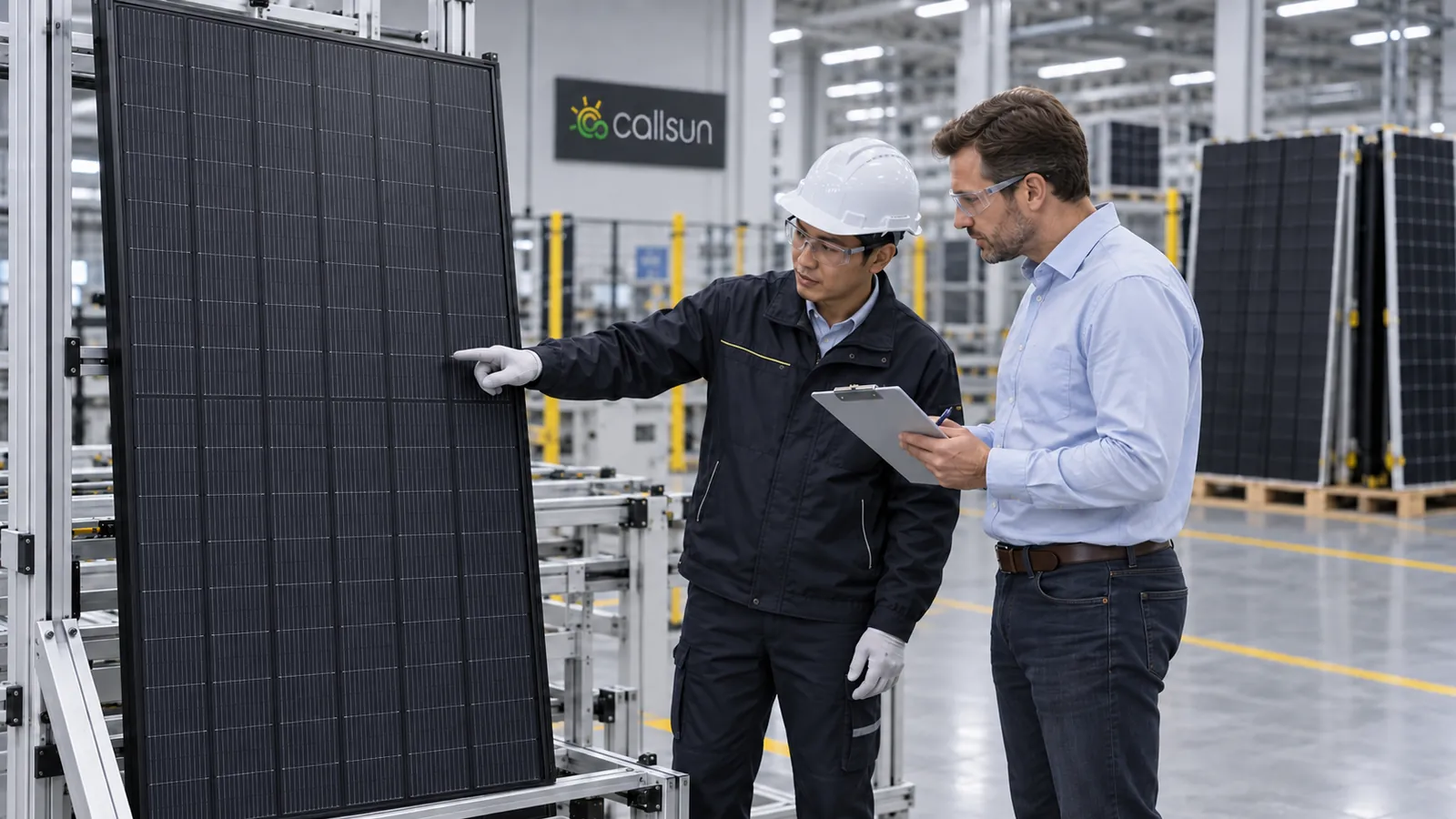
Callsun, a PV module brand and manufacturer with in-house development, manufacturing and testing capabilities, operates automated standard-module production alongside semi-automated custom glass module manufacturing — both routes integrate in-process EL inspection and final EL and I-V testing. A stage-by-stage guide to verifying which processes a supplier controls in-house is covered separately in How to Evaluate a PV Module Manufacturer: A Practical Guide for B2B Buyers.
The purpose of these two production approaches is not to present one as better than the other. They are designed for different manufacturing requirements: automation supports consistency and volume delivery for standard products, while flexible production supports engineering adaptation and sample validation for non-standard products.
Evaluate Product Fit Beyond Rated Wattage
Rated wattage is important, but it should not be evaluated in isolation.
For standard PV modules, buyers should consider power density, physical dimensions, electrical parameters, installation area, and compatibility with the planned system. A higher-wattage module may help increase installed capacity when roof area or module count is limited, but only when its size and electrical characteristics are suitable for the project.
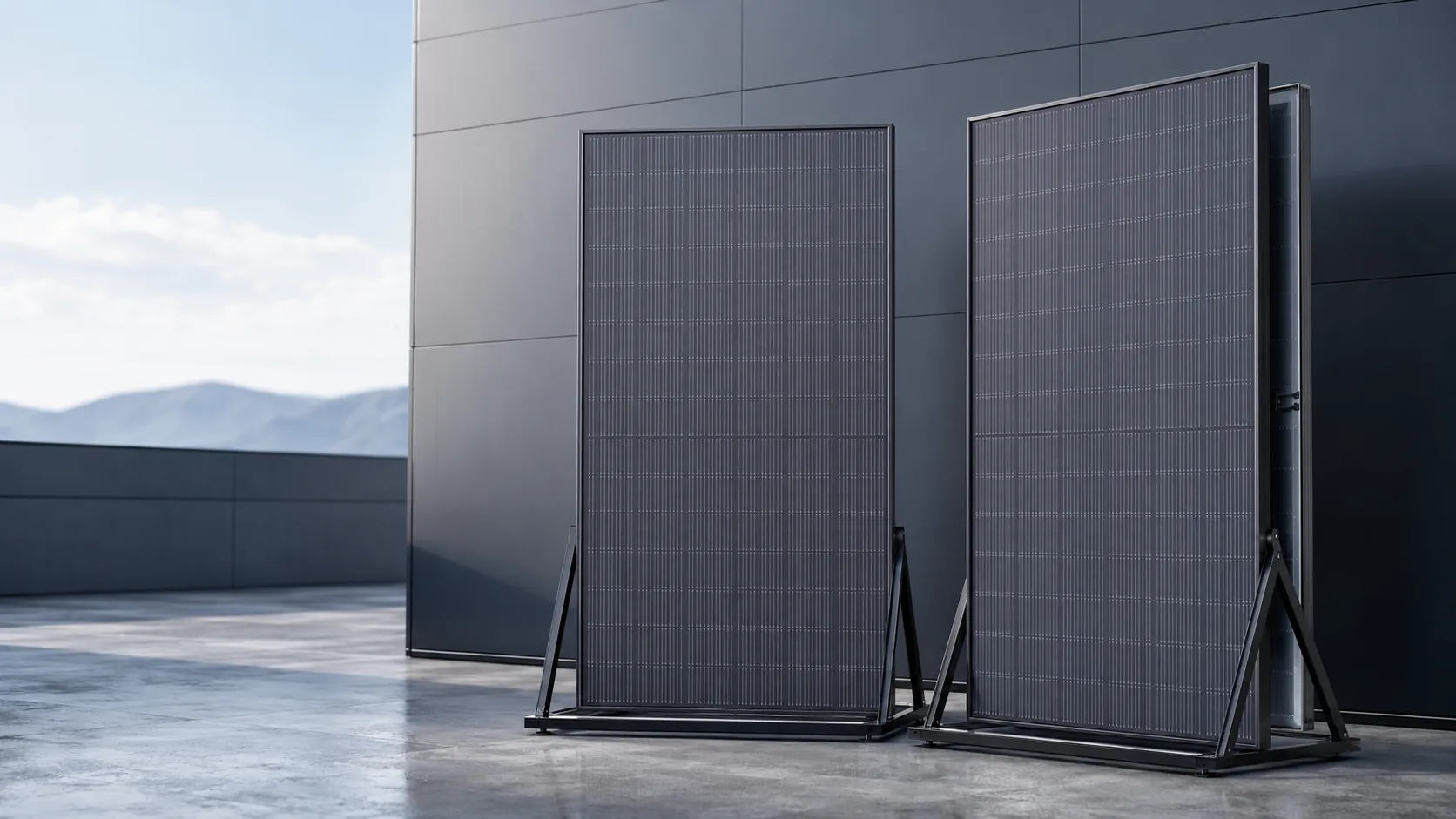
Callsun’s standard module portfolio covers 450W, 580W, 620W, and 720W power classes, serving applications such as residential rooftops, distributed PV, off-grid systems, and small commercial and industrial projects.
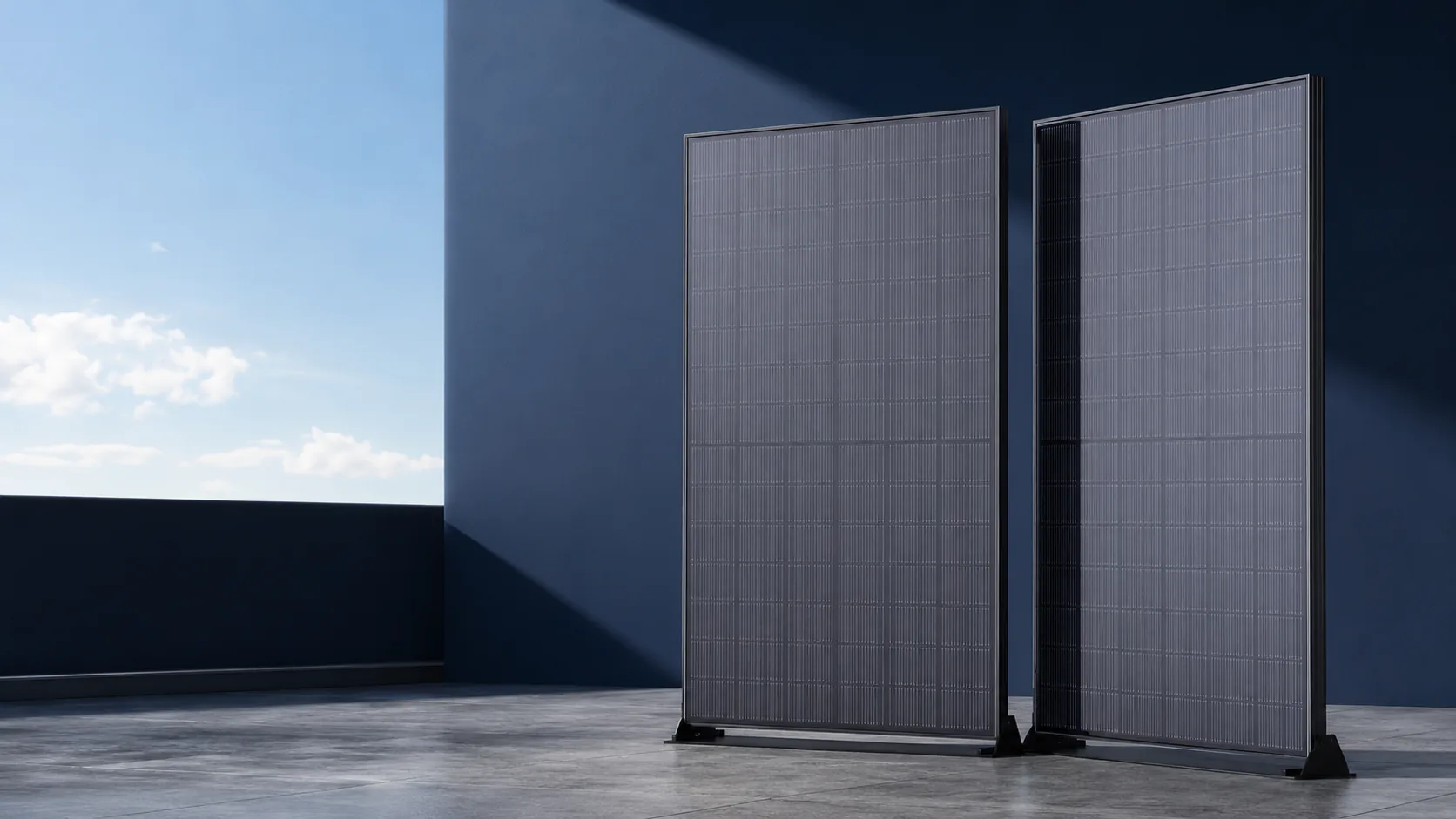
When conventional module dimensions do not fit the available space, the project may require a custom module assessment. Callsun offers representative custom glass modules in 180W, 200W, and 215W power classes for applications including RVs, vehicle rooftops, balconies, off-grid equipment, and other space-constrained installations.
Custom development, however, is not simply a matter of changing the length or width of a panel. Module dimensions affect cell layout, target output, electrical design, structural configuration, cable routing, connectors, and installation compatibility. These variables must be considered together before a sample is produced.
A reliable supplier should also be willing to explain when an existing standard product is sufficient. Custom engineering adds the most value when the project has a clear limitation that a standard module cannot reasonably address.
Look at Quality Control as a Process
Quality control should not be reduced to a list of test equipment or a general statement that every module is inspected.
Buyers should ask where inspections occur in the manufacturing process, what each test is intended to verify, and how the results are used before the product is released.
Electroluminescence, or EL, inspection helps examine cell and internal interconnection conditions that may not be visible through an external inspection. Depending on the product and production line, in-process EL inspection can be conducted after string welding or before lamination to identify issues such as hidden cell cracks and soldering abnormalities.
Final EL inspection after lamination and framing provides another opportunity to check the condition of the cells and internal connections after the main assembly processes have been completed.
Simulated-sunlight I-V testing serves a different purpose. It records output power, voltage, current, and the I-V curve under controlled test conditions to verify the module’s rated power class and factory release requirements.
Neither test should be treated as a complete guarantee of long-term field performance on its own. They are parts of a wider quality-control process that also includes raw-material control, inspection of semi-finished products, visual examination, electrical safety checks, outgoing inspection, and reliability validation.
For B2B buyers, the important question is therefore not simply whether a manufacturer owns an EL tester or solar simulator. It is whether these tools are integrated into a controlled and repeatable manufacturing process.
Verify Documentation for the Exact Product and Market
Technical and compliance documents should be checked at the model level rather than assumed to apply to an entire product range.
Before placing an order, buyers should review the product datasheet, electrical parameters, dimensions, mechanical construction, connector information, applicable test reports, and certification documents relevant to the destination market. The legal entity, product model, standard, issuing organization, and validity of each document should be confirmed.
This is especially important when a supplier offers several power classes, different glass or frame structures, or both standard and custom products. A document associated with one model should not automatically be treated as evidence for another.
Project-specific requirements may also extend beyond module documentation. Local electrical codes, installation standards, system design requirements, and permitting rules must be reviewed by qualified professionals in the relevant market.
A responsible manufacturer should provide accurate product information while remaining clear about the limits of its role. Final system selection and installation approval belong to the appropriately qualified project parties.
Use Sample Validation to Reduce Volume-Production Risk
A sample is not only a product for visual approval. It is an opportunity to verify whether the proposed module matches the project requirements before volume production begins.
For a standard module, sample evaluation may focus on physical dimensions, electrical characteristics, appearance, packaging, connectors, and compatibility with the intended system or installation method.
For a custom module, the validation process may also need to examine structural fit, cell layout, cable position, interface requirements, mounting conditions, and performance under the expected application environment.
Before approving a sample, both parties should document which specifications are fixed and which may still change. This creates a clearer reference for production validation and reduces the risk of disagreement during volume delivery.
The manufacturer should also explain how the approved requirements are transferred into production. This may include controlled drawings, product specifications, inspection criteria, packaging requirements, and other records appropriate to the project.
The objective is not to assume that one successful sample automatically proves the consistency of every future production batch. It is to establish a defined and verifiable basis for moving from sample validation to repeatable manufacturing.
Assess Supply and Delivery Support Realistically
Manufacturing capability must ultimately connect with the buyer’s delivery requirements.
Buyers should discuss the destination market, product availability, order quantity, packaging, shipping method, delivery schedule, and required documentation before confirming an order. For recurring wholesale business, it is also useful to understand how future orders, product updates, and market materials will be coordinated.
Callsun’s manufacturing and supply network spans China, Vietnam, Indonesia, Saudi Arabia, and other regions. Warehousing and logistics resources support local delivery in markets including the United States, the United Kingdom, Germany, Australia, Canada, and Japan.
A multi-regional network can provide greater flexibility in responding to market, trade, and logistics changes. However, buyers should still confirm the actual production location, stock status, shipping arrangement, and delivery conditions for each specific order. A general global footprint should not be interpreted as guaranteed local availability for every model.
For distributors and wholesalers, Callsun supports product portfolio planning, specification documents, and marketing materials. For installers and system providers, support may include confirmation of module dimensions, electrical parameters, compatibility, and installation conditions. For equipment manufacturers and project buyers, the process may extend to custom feasibility assessment, sample trials, and transition to volume production.
A Practical Manufacturer Evaluation Checklist
Before selecting a solar panel manufacturer, buyers should be able to answer the following questions:
- Does the supplier understand the intended application and target market?
- Are the proposed dimensions and electrical parameters suitable for the project?
- Which engineering, manufacturing, and testing processes are handled in-house?
- Can the manufacturer support both sample validation and repeatable volume production?
- Where do EL inspection and I-V testing occur in the production process?
- Are the technical and compliance documents applicable to the exact model being purchased?
- Does the product require standard supply or custom engineering?
- Have packaging, logistics, delivery conditions, and responsibilities been confirmed?
- Is there a clear communication process for technical questions and future orders?
A strong manufacturing partner does not need to provide the same answer to every project. It should be able to identify the relevant constraints, explain the available options, document the agreed requirements, and support a controlled path from product selection to delivery.
From Product Requirements to Consistent Delivery
Choosing a solar panel manufacturer is ultimately a risk-management decision.
The right partner should combine suitable products, transparent engineering communication, controlled manufacturing, verifiable quality processes, accurate documentation, and realistic delivery support. Price remains an important part of the decision, but it should be considered alongside the cost of specification mismatch, inconsistent production, incomplete documentation, and delivery uncertainty.
Callsun is a PV module brand and manufacturer with in-house R&D, manufacturing, and testing capabilities. We support distributors, installers, system providers, equipment manufacturers, and project buyers across standard module selection, custom engineering assessment, sample validation, and volume delivery.
Contact Callsun to discuss your target power, module dimensions, installation conditions, destination market, and project requirements.
Tagged
Next step
Choose a manufacturing partner you can verify.
Share your target power class, module dimensions, application, destination market and forecast volume—Callsun will match standard modules or open a custom engineering assessment with sample validation.
Contact Callsun